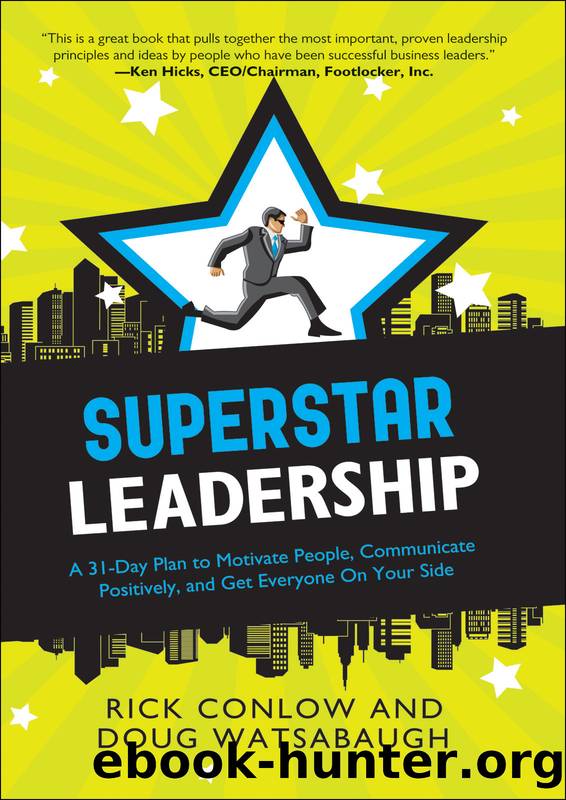
Superstar Leadership by Rick Conlow
Author:Rick Conlow
Language: eng
Format: epub
Publisher: Red Wheel Weiser
Published: 2013-01-15T00:00:00+00:00
What did you learn or relearn in this section?
What formal recognition methods will you use and why?
Which of your employees deserve formal recognition, and how will you recognize them?
The unexamined life is not worth living.
âSocrates
DELIVERING EFFECTIVE TRAINING
DAY 17: Taking Time to Train
DAY 18: The STAR Training Process
DAY 19: Training Principles
Day 17
TAKING TIME TO TRAIN
Many bosses claim they donât have time to train. The better question is whether you have time not to train. If you provide ongoing learning opportunities for your employees, they will perform better. When they grow and learn, they are better able to try new things and make positive changes in their behavior because they have the confidence and ability to succeed. As we discussed earlier, this is a key component of employee motivation.
Fortune Magazine, as we have identified, annually selects the best hundred companies in the United States to work for. The company descriptions reveal a common characteristic: training. Fortuneâs top-rated companies habitually provide 40, 50, 60, and 100-plus hours of training per year for all employees. We have already provided research to support the importance of ongoing training; here are a couple more:
Forty-one percent of employees at companies with poor training plan to leave within a year, versus 12 percent of employees at companies with excellent training.1
Companies that spend $273 per employee per year on training average 7-percent voluntary turnover compared with 16 percent for companies that average $218 per employee per year.2
As a manager, you donât have time not to train. Regular training is the key to employee effectiveness. Without it, other departments and other companiesâyour competitionâwill outperform you.
Managers also tend to excuse their non-training approach by saying, âI am not a trainer.â Although that may be a fair assessment, training is a skill set that can be learned. If you are a manager who doesnât know how to train, you can begin the learning process now.
There are two areas to consider for training: the content and the process. In what areas do your employees need training (content), and how and by whom should that training be conducted (process)?
Content depends greatly on the type of job, but it can usually be defined by the technical and the interpersonal aspects (people skills). A sales rep needs technical training in product knowledge, paperwork, company procedures, and customer relationship management tools, as well as interpersonal training in consultative sales and customer service. A customer service rep needs similar training but with greater emphasis on the customer service skills. New hires need comprehensive training from A to Z. Experienced employees need training for new products, new software tools, policy changes, and refresher training on interpersonal skills. Ongoing reinforcement training is what separates the best from the rest. Too many companies and managers give all the training the first year on the job and then stop.
Reinforcement or supportive training helps people:
Relearn what they forgot.
Remind them of the proper way to do a skill.
Focus on doing things the right way.
Prevent bad habits from taking over.
Learn from others and from their own mistakes.
Download
This site does not store any files on its server. We only index and link to content provided by other sites. Please contact the content providers to delete copyright contents if any and email us, we'll remove relevant links or contents immediately.
The Brazilian Economy since the Great Financial Crisis of 20072008 by Philip Arestis Carolina Troncoso Baltar & Daniela Magalhães Prates(147904)
International Integration of the Brazilian Economy by Elias C. Grivoyannis(111105)
The Art of Coaching by Elena Aguilar(53295)
Flexible Working by Dale Gemma;(23300)
How to Stop Living Paycheck to Paycheck by Avery Breyer(19742)
The Acquirer's Multiple: How the Billionaire Contrarians of Deep Value Beat the Market by Tobias Carlisle(12341)
Thinking, Fast and Slow by Kahneman Daniel(12334)
The Radium Girls by Kate Moore(12047)
The Art of Thinking Clearly by Rolf Dobelli(10517)
Hit Refresh by Satya Nadella(9147)
The Compound Effect by Darren Hardy(8993)
Tools of Titans by Timothy Ferriss(8421)
Atomic Habits: Tiny Changes, Remarkable Results by James Clear(8361)
Turbulence by E. J. Noyes(8063)
A Court of Wings and Ruin by Sarah J. Maas(7869)
Change Your Questions, Change Your Life by Marilee Adams(7798)
Nudge - Improving Decisions about Health, Wealth, and Happiness by Thaler Sunstein(7718)
How to Be a Bawse: A Guide to Conquering Life by Lilly Singh(7502)
Win Bigly by Scott Adams(7210)
